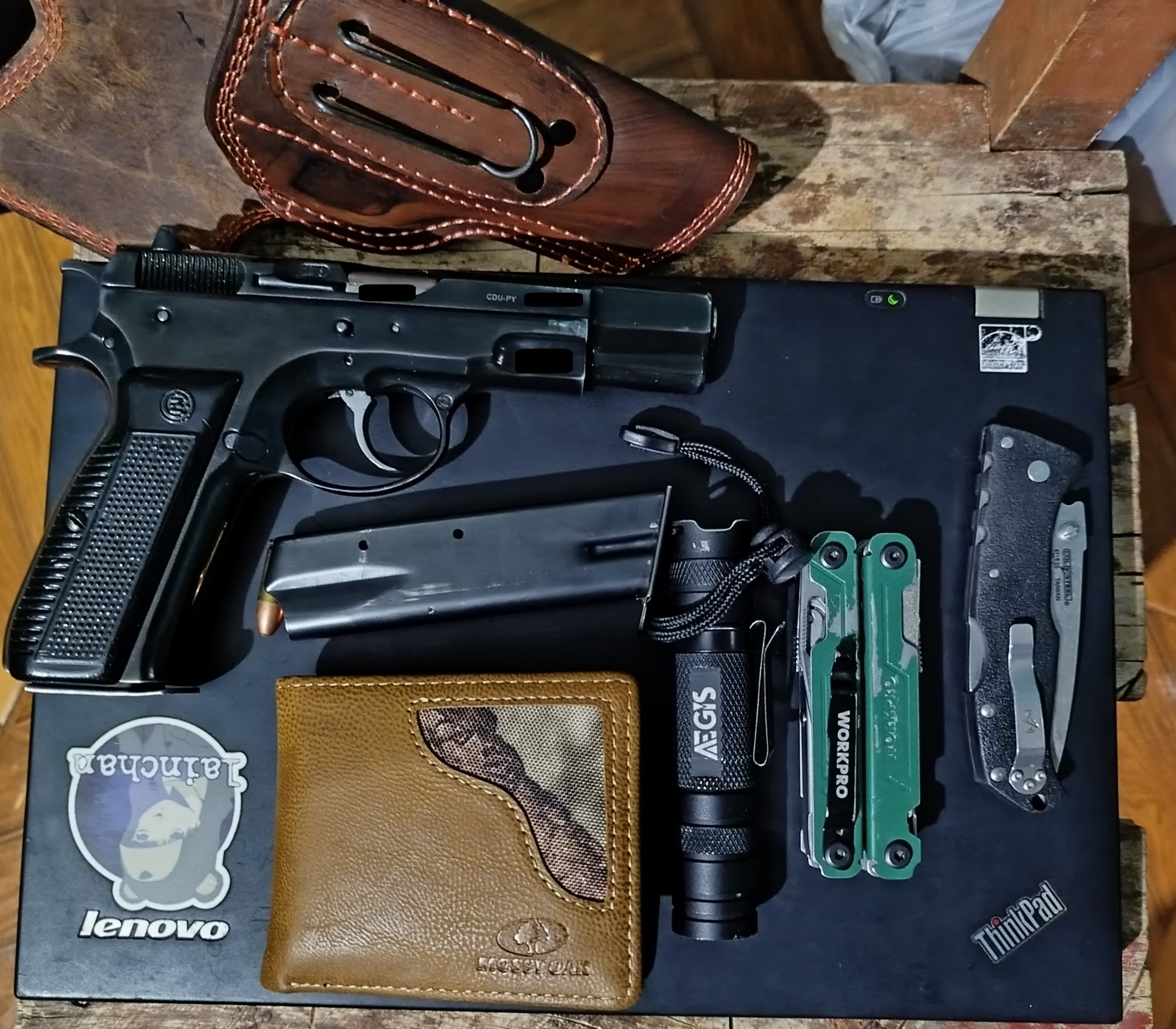
CZ75 Pre-B

CZ needs no introduction for most gun enthusiasts. The original CZ75 was designed by brothers Josef and František Koucký in Czechoslovakia. Following the post-WWII communist coup d'état, all heavy industry was nationalised and cut off from Western export markets behind the Iron Curtain. While most other Warsaw Pact countries became dependent on armament imports from the Soviet Union, Czech weaponry remained largely domestic. The nation constantly acted as the Pact's black sheep, famously adopting the Vz52 instead of the Tokarev, and the Vz58 instead of the AK-47.
Brothers Josef and František Koucký participated to some extent in designing all of CZUB's post-war weapons. The Koucký brothers signed their designs together, using only their surname. By 1969, František Koucký was newly retired, but the company offered him a job designing a new 9×19mm Parabellum pistol. Unlike in his previous work, he was given complete freedom to design the entire handgun from scratch.
The Model 75 was developed strictly for export purposes, as the standard cartridge of the Czechoslovak forces was the 7.62×25mm Tokarev, which was later replaced by the Warsaw Pact standard 9mm Makarov. Koucký's domestic patents regarding the design were classified as "secret patents". Consequently, nobody in Czechoslovakia could learn of their existence or register the same design. At the same time, both Koucký and the company were prohibited from filing for patent protection abroad. This lack of international protection led to numerous foreign companies copying the CZ75 design, most notably the Israeli IWI Jericho, Italy's Tanfoglio, Norinco's NZ75, the Swiss Sphinx, the Turkish Sarsilmaz, and the American Bren Ten.
The CZ 75 Pre-B is the original iteration of the model. It was nicknamed this way after CZ introduced the modernised "75 B" variant from 1993 onwards. Unlike the later B models, the Pre-B lacks a firing pin block, features a distinct rounded trigger guard, and relies heavily on hand-fitted, all-steel craftsmanship.
This specific CZ75 is dated 1981, sporting a low, numeric-only five-digit serial number. It originally sat in the store with aftermarket walnut grips. However, after I asked the shop owner if the original grips were still around, he located them and threw them in free of charge, which was a very welcome addition.

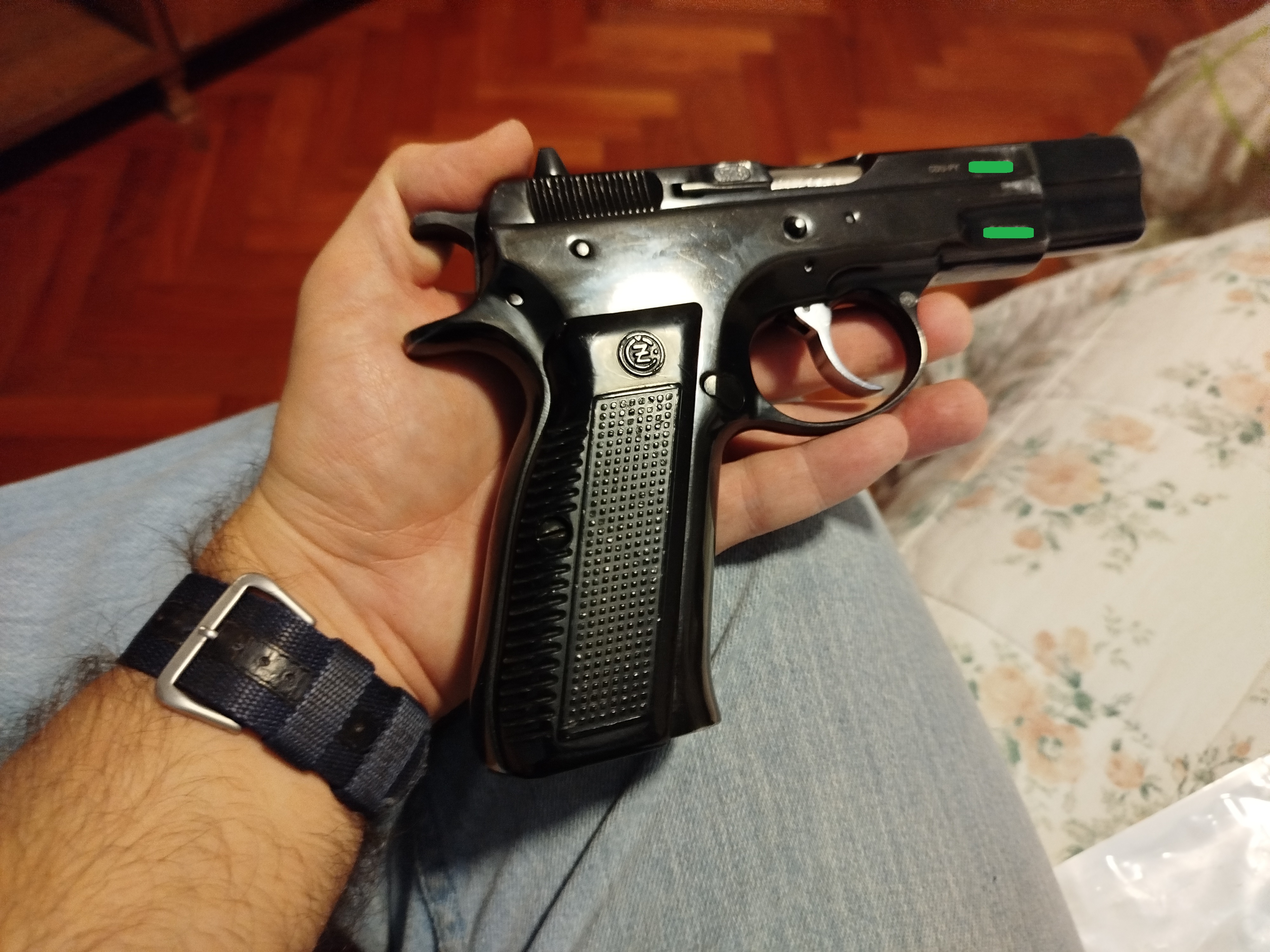
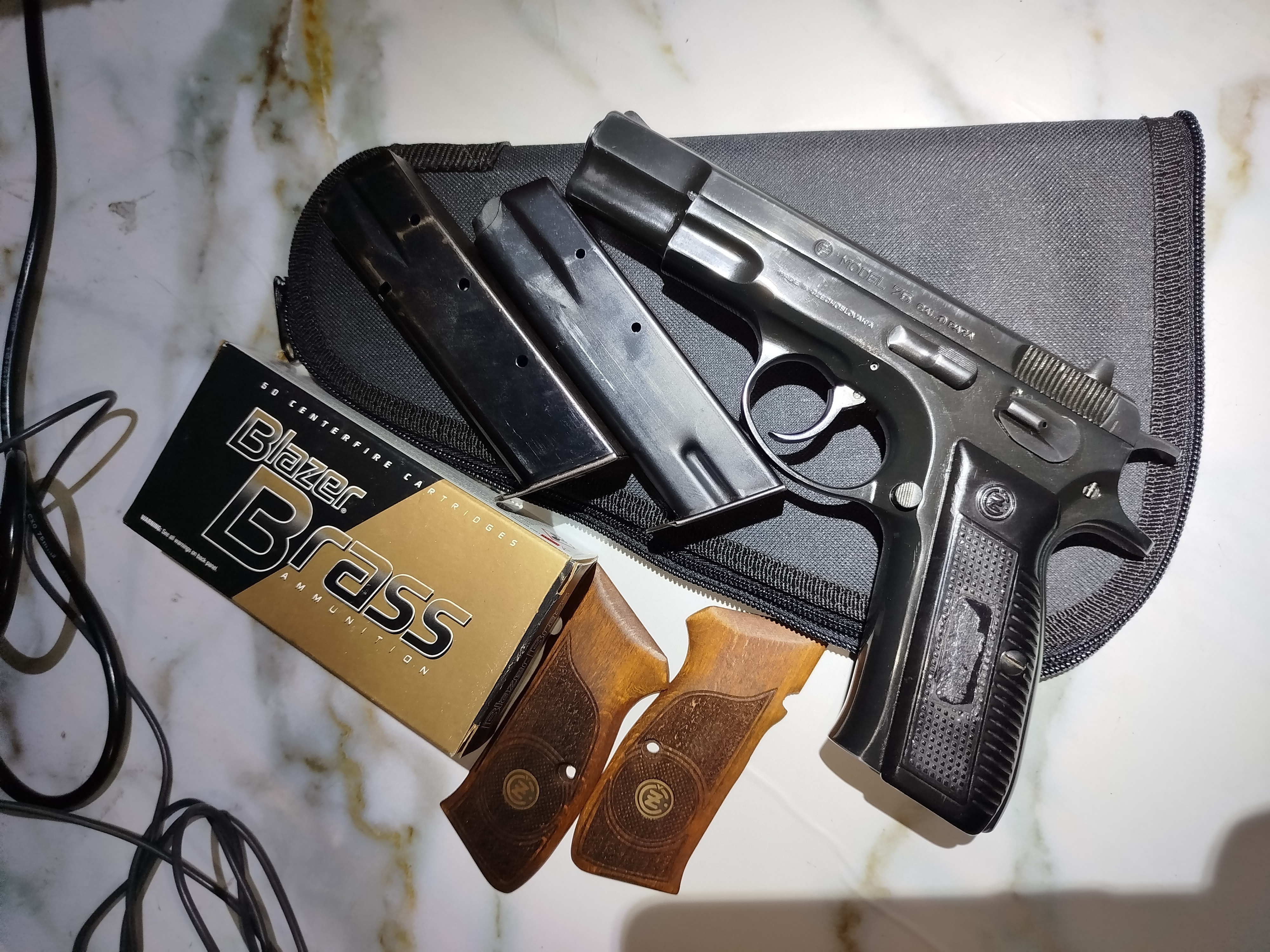
On the left is everything I received from the store: the gun inside a soft case, the aftermarket walnut grips, the original grips, and two slightly different spare magazines.
On the right, you can see how the original Bakelite grips look. I absolutely love their old-school aesthetic and tactile feel.
Older Pre-B models do not always accept modern CZ75B magazines due to slight differences in frame geometry. However, mine successfully accepted magazines from a CZ75 SP01 Phantom that the store had in stock. Both magazines locked the slide open, which was a huge selling point for me. Later Pre-B variants that accept modern CZ75B magazines are often called "transitional models". These transitional versions sometimes also feature CZ75B traits, such as a commander-style hammer or a squared trigger guard.
There is a common misconception widely spread across Guntube and the internet that the CZ75 has a "low bore axis". However, this could not be further from the truth. The bore axis—the distance or height of the chamber relative to where your hand sits—is actually the same as most common handguns. The real difference lies in the CZ75's slide riding inside the frame rails rather than outside them. This design results in less reciprocating mass, which is what actually creates the reduced felt recoil impulse.
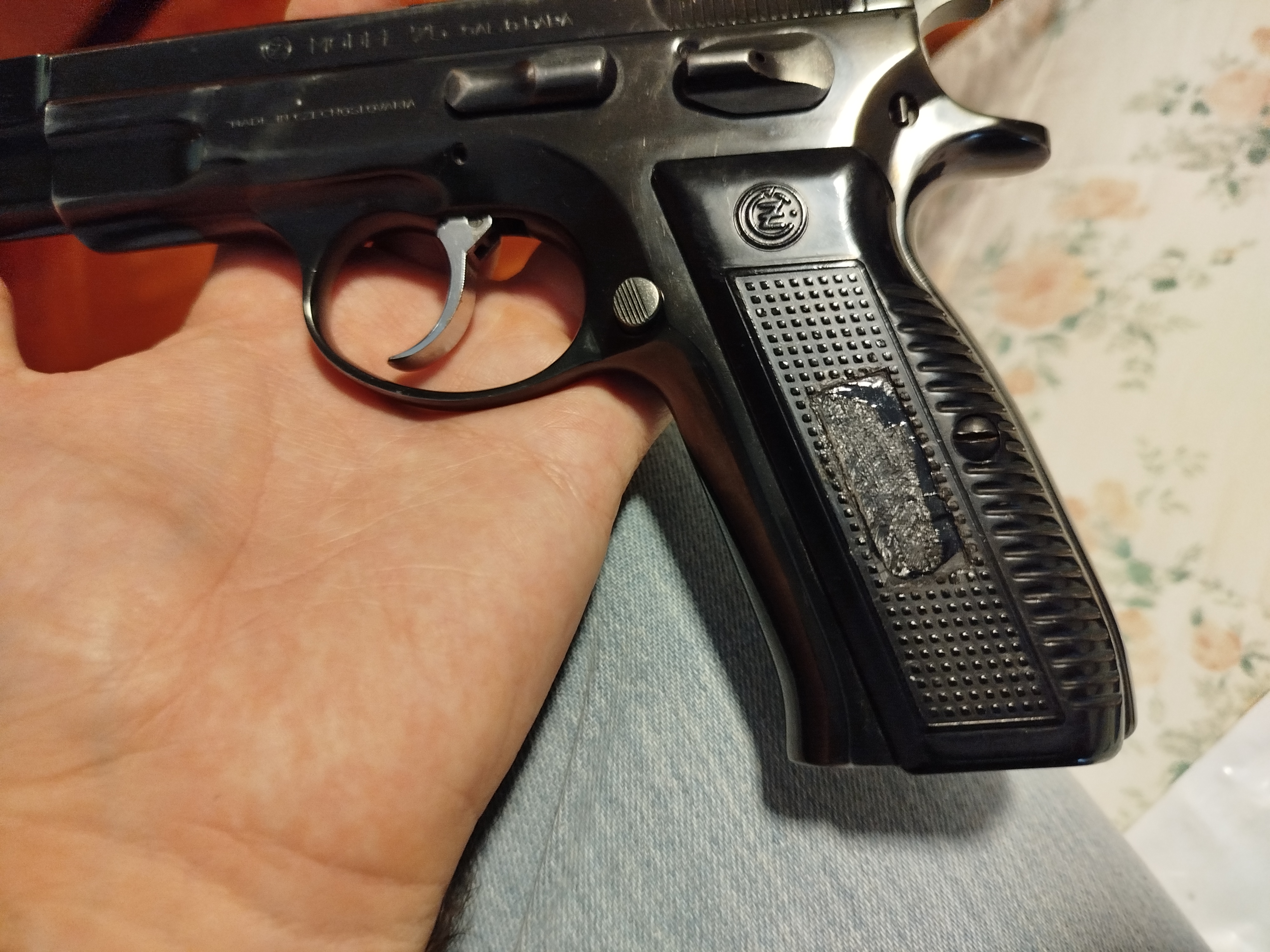
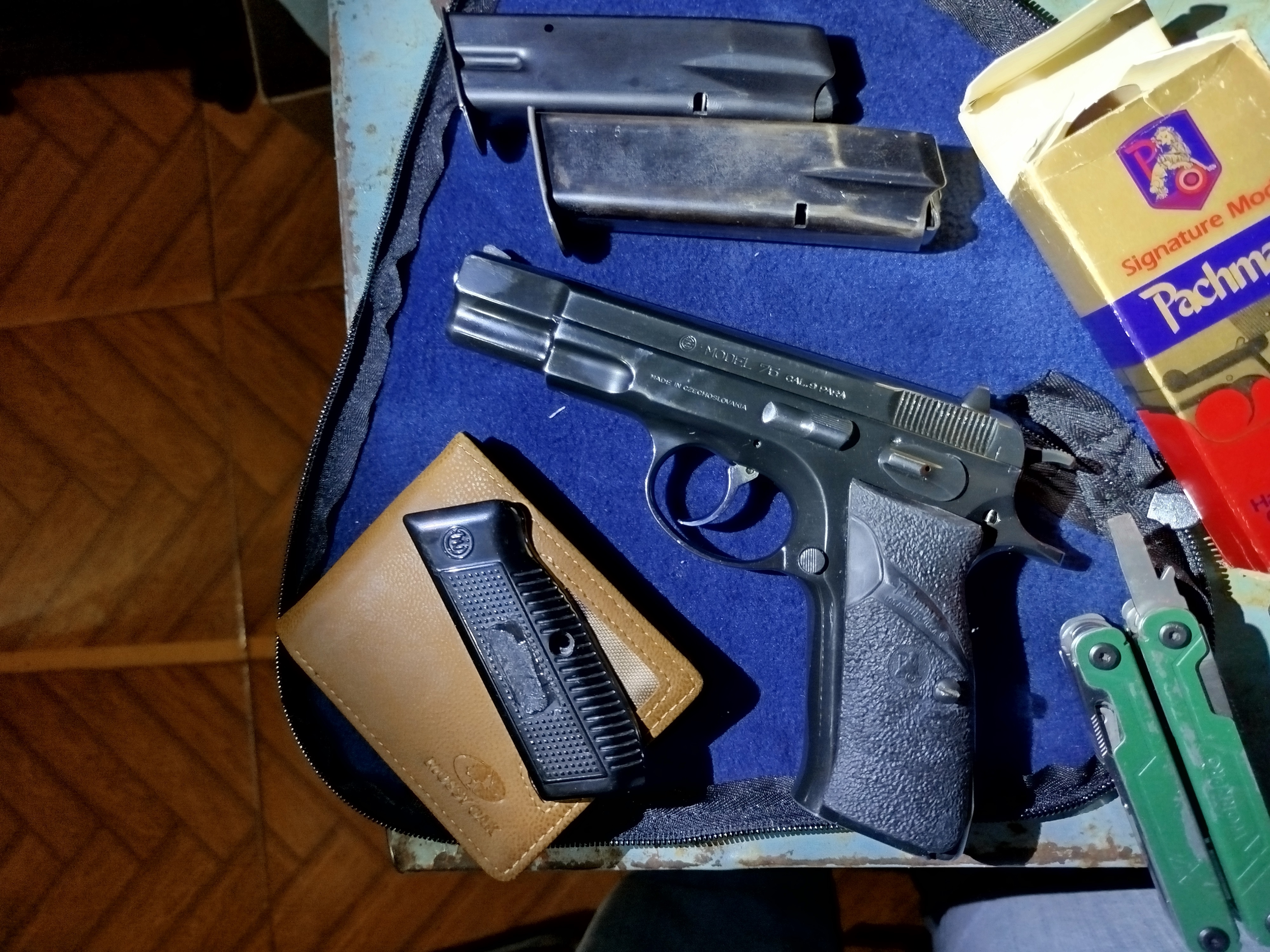
The left-side original factory grip has a strange mark, almost as if something was glued or melted onto it. Perhaps a previous owner tried to mount an early, vintage laser system to these panels?
This blemish led me to purchase a set of Pachmayr grips, though the factory screws currently on the gun are slightly too thick to fit through them.
As a surplus handgun from 1981, the internals suggest this example does not have a high round count. The trigger has broken in beautifully, yielding a very smooth double-action pull. Resting the hammer on the half-cock notch not only shortens the reach for my trigger finger, but it also creates a perfect middle ground between the heavy double-action and the incredibly crisp single-action pull. The iron sights are completely blacked-out and squared, with no recessed dots for luminescent paint. For now, I plan to leave them exactly as they are.
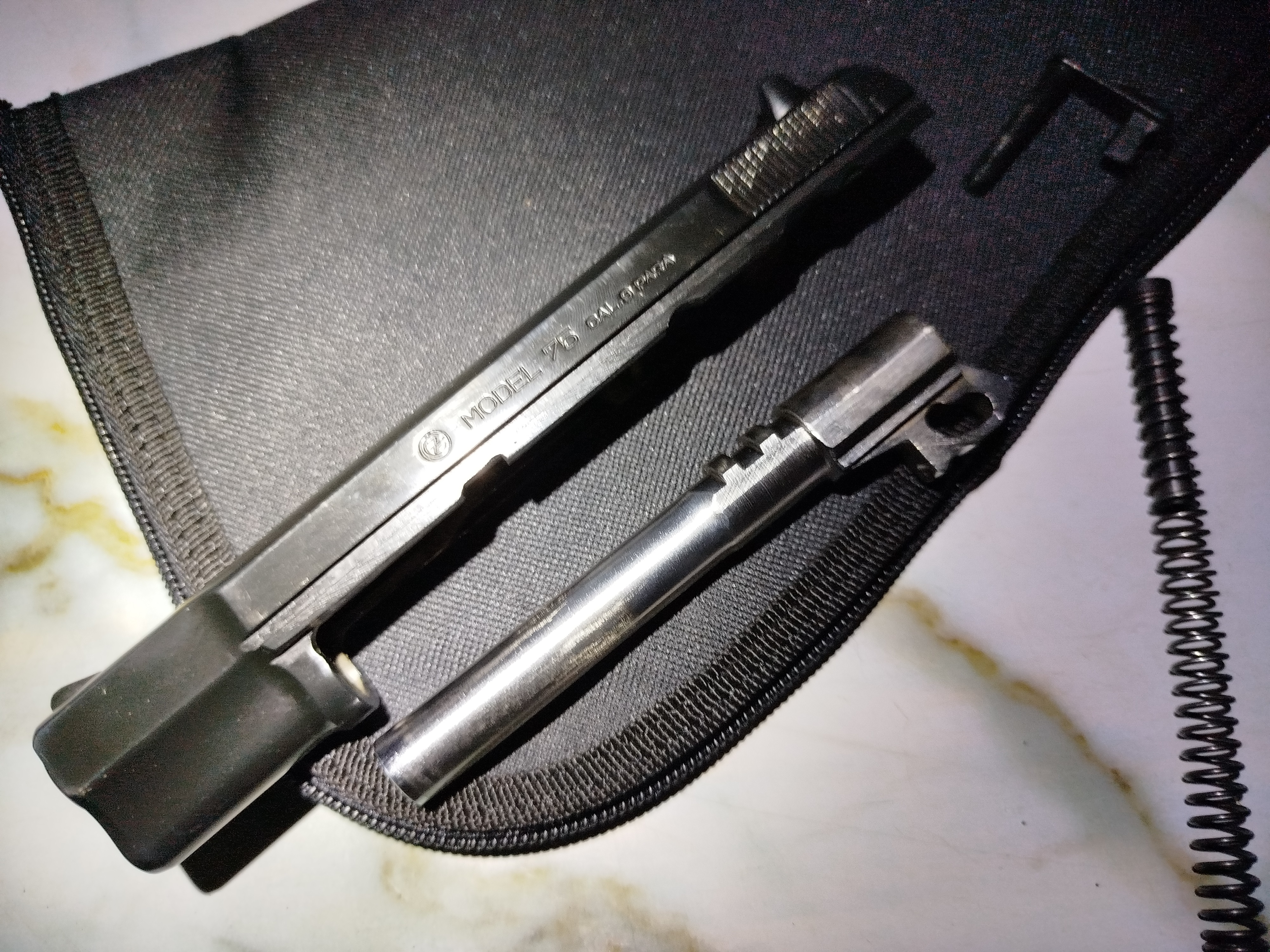
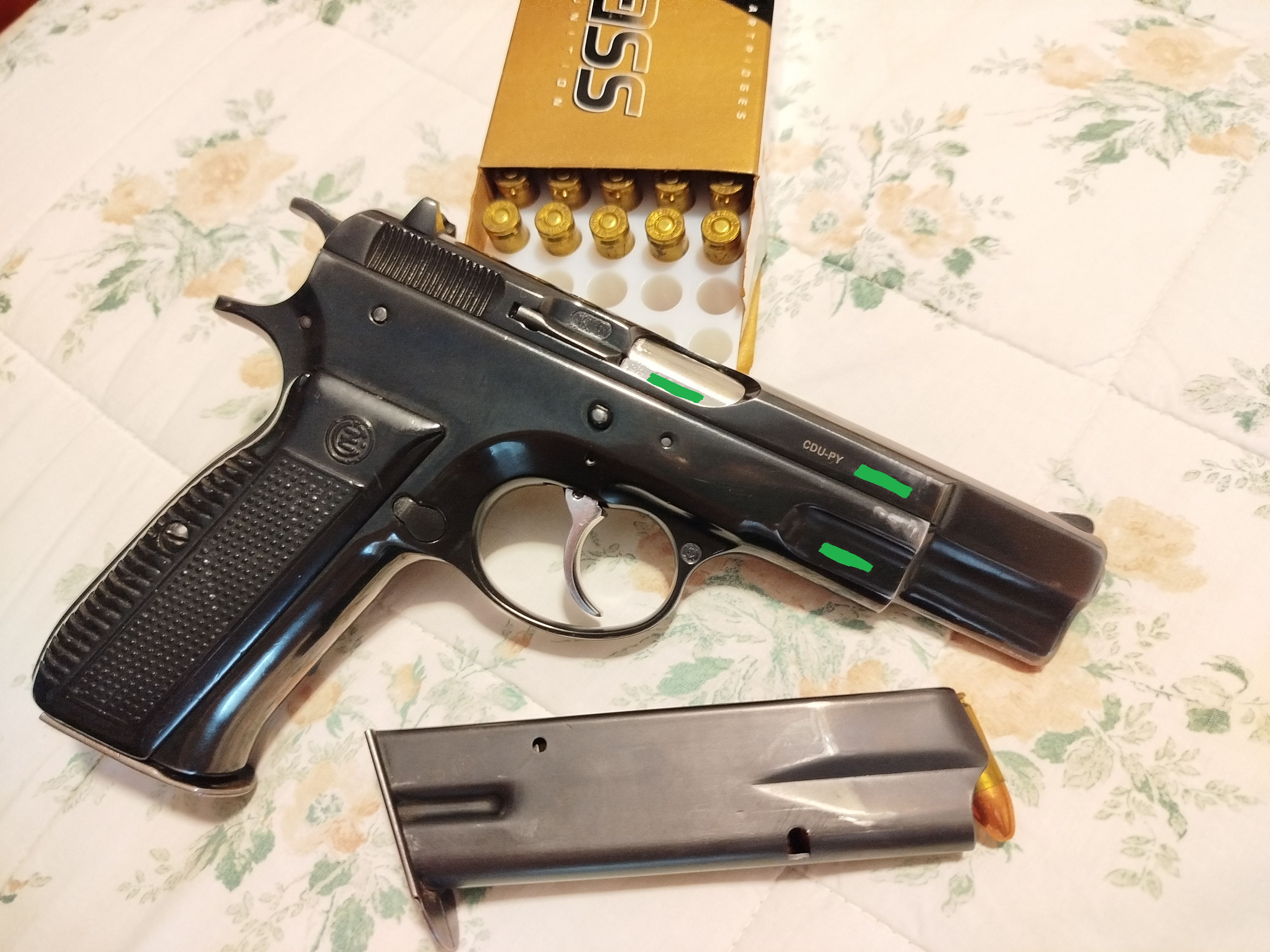
There is some minor wear on the bluing near the front of the frame on both sides, which appears to be holster wear.
This is the first firearm I have purchased since moving to Paraguay as an expat from Brazil—making me a Brasiguayo. The process of buying a gun here is much simpler and faster than what I am used to. Once you have a permanent residency card, the only extra requirement compared to a native citizen is an INTERPOL background check to obtain a ownership permit. Think of it like a driver's license: it must be renewed every five years, requires a background check, and is tied to a registered address (though if you move, you only need to update it upon renewal). Once you have the permit, you can purchase as many guns as your wallet allows.
The system actually improved with the 2024 gun bill. This legislation was partially pushed by the US government due to a perceived "lack of control on imports". The US demanded that Paraguay update its gun laws and implement a new electronic system for gun registration instead of relying on paper records. Back in 2022, the ATF stopped issuing export licenses for Paraguay, which led to a local scarcity of US-made firearms and ammunition. As a result, most guns in stores and virtually all ammunition in stock come from Europe, Turkey, Argentina, and Brazil. Because Paraguay has no import bans, if I had the money, I would love to flood the market with cheap Tula ammo and Norinco firearms. Some older Norinco models can still be found around here, like their 1911s and M14s.
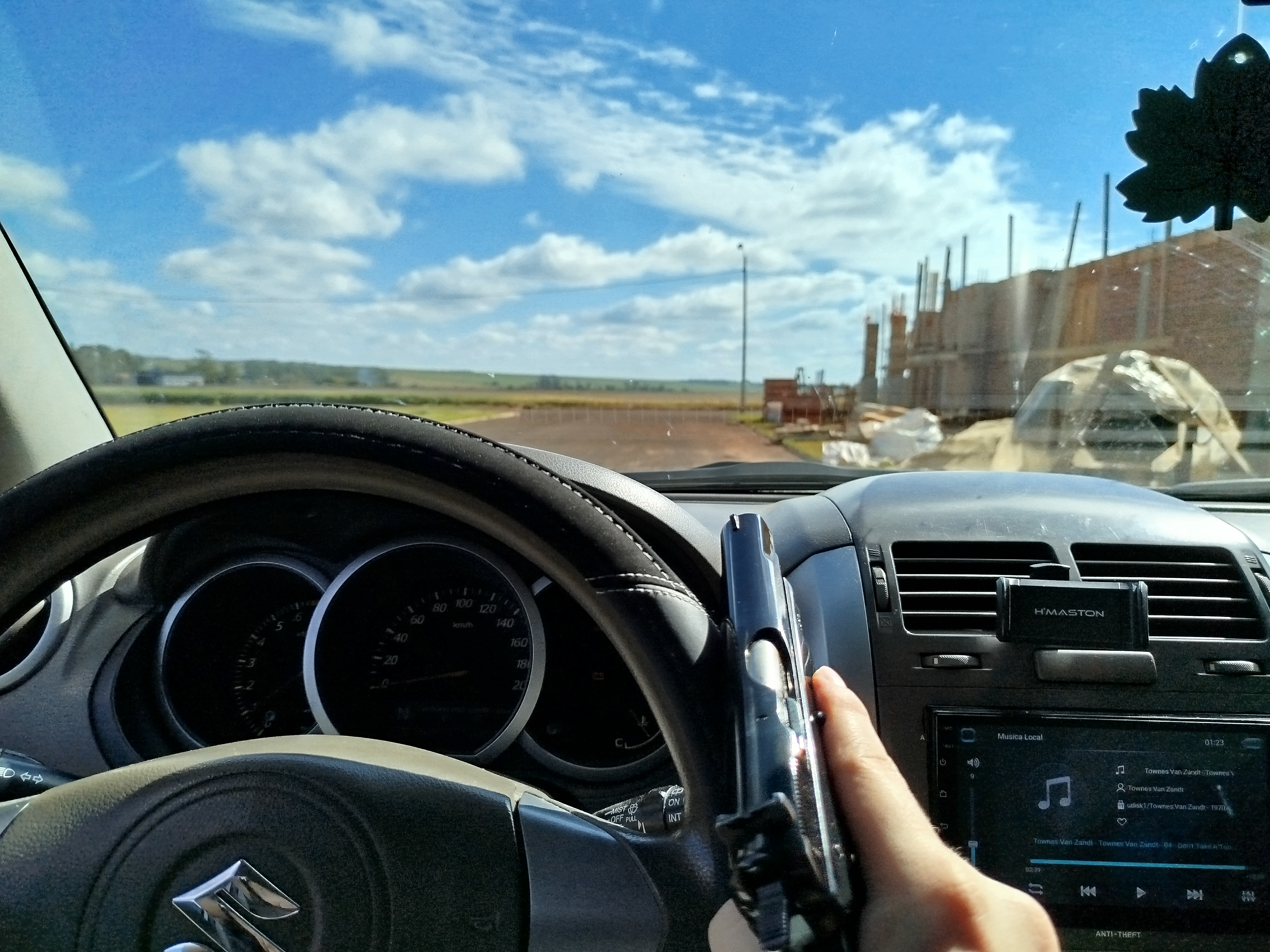
Taking it out for a ride, it makes a great truck gun.
After my ownership permit was approved, I bought this gun with cash at the store for 7,000,000 guaranis (roughly $1,000 USD at the time, though the PYG exchange rate has strengthened lately). The shop gave me the bill of sale and receipt, which I took to the police station so they could add the gun to my "inventory". While there, I also picked up my physical permit card, which had been issued but not yet collected. Afterward, I simply drove back to the store, picked up the gun, and bought some ammo. The entire process was completed in a single morning in Asunción—which is certainly better than a lot of blue states in the US.
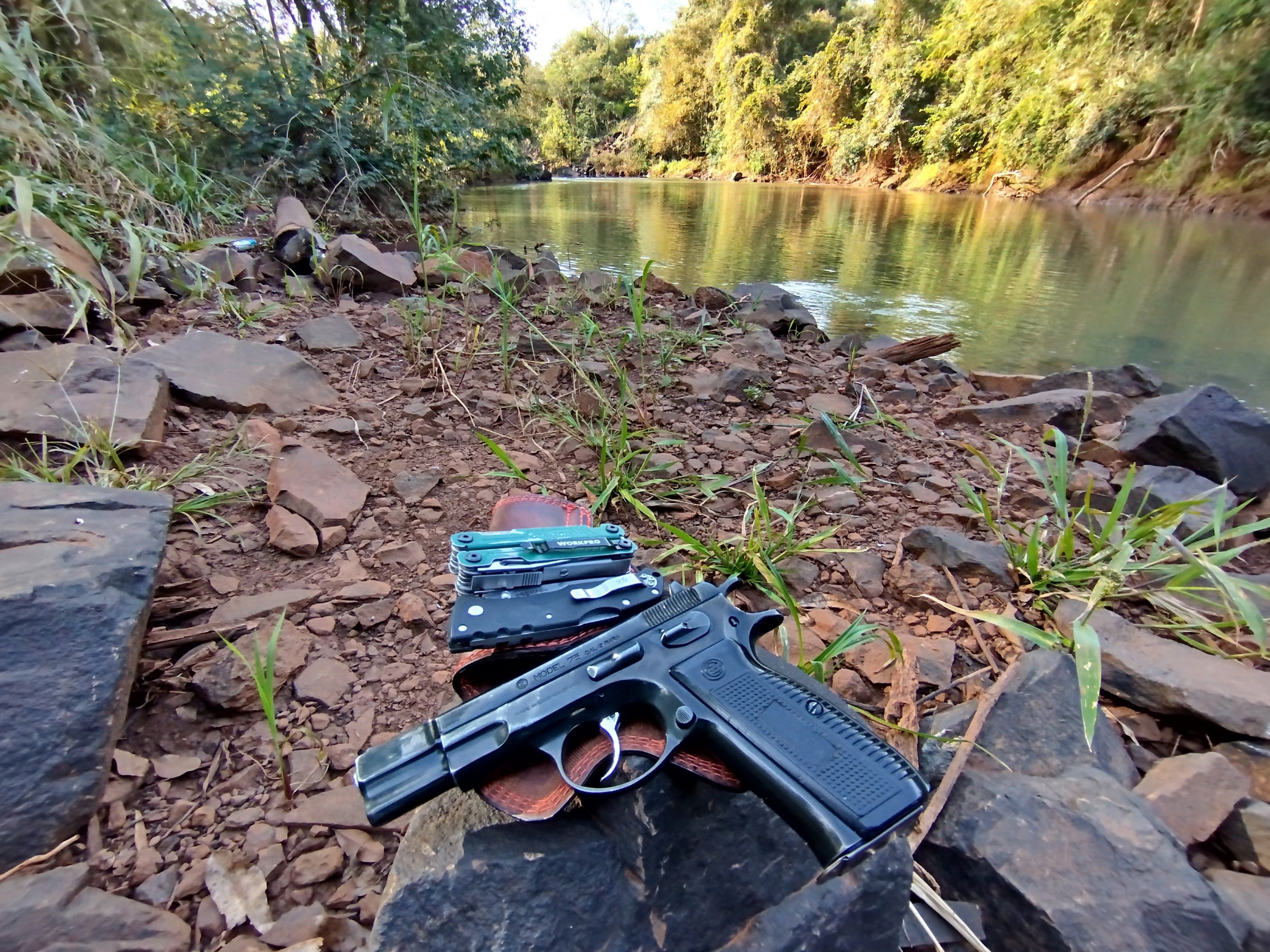
One of the magazines has a dent near the baseplate, but both still hold 15 rounds. My first shots with it were out in the woods by the river under a bridge. How good it feels to be free!
I just couldn't pass up this deal. It was cheaper than a new-production CZ75B at Chaco Outdoors, the official CZ retailer in Paraguay. It is in excellent condition and fits modern magazines. While it is more of a collectible than a practical everyday handgun, I might start using it for IPSC matches or while hiking. For now, it serves as my home defence gun. I do not plan on carrying it regularly, though I did buy a leather IWB holster and tried carrying it at the 3 o'clock position for a bit during the winter.
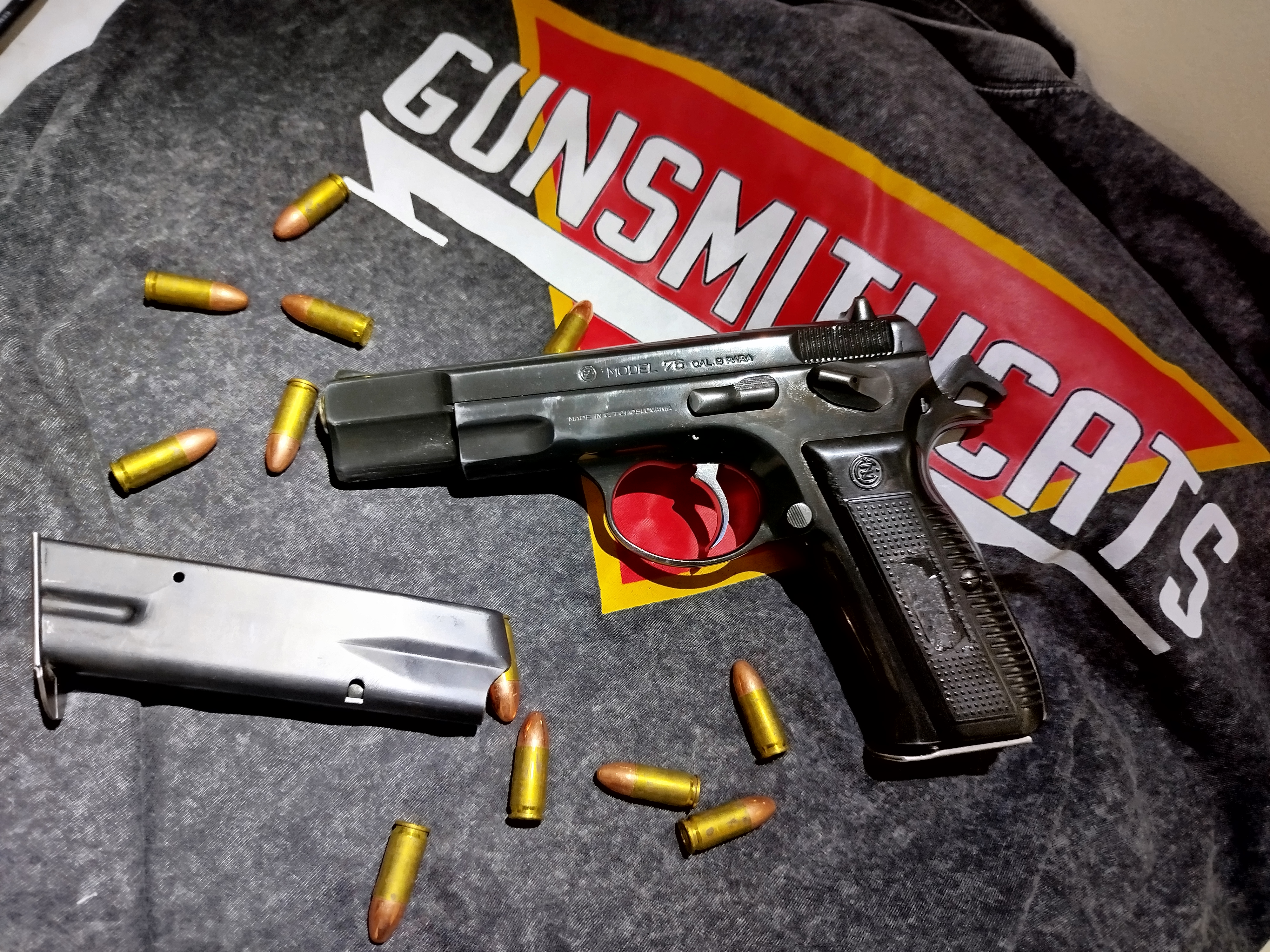
An obligatory Gunsmith Cats reference is required here, even though this isn't a "Short Rail" variant.
I still need to do some research to see if modern CZ75B parts—such as extractors, springs, and firing pins—will fit this gun. Since these components will inevitably wear out over the years and with higher round counts, their compatibility will be the decisive factor in whether I use this pistol for IPSC or just keep it as a collectible. Ultimately, using a much more common Argentine FM Hi-Power as a "beater" gun might be the wiser decision.
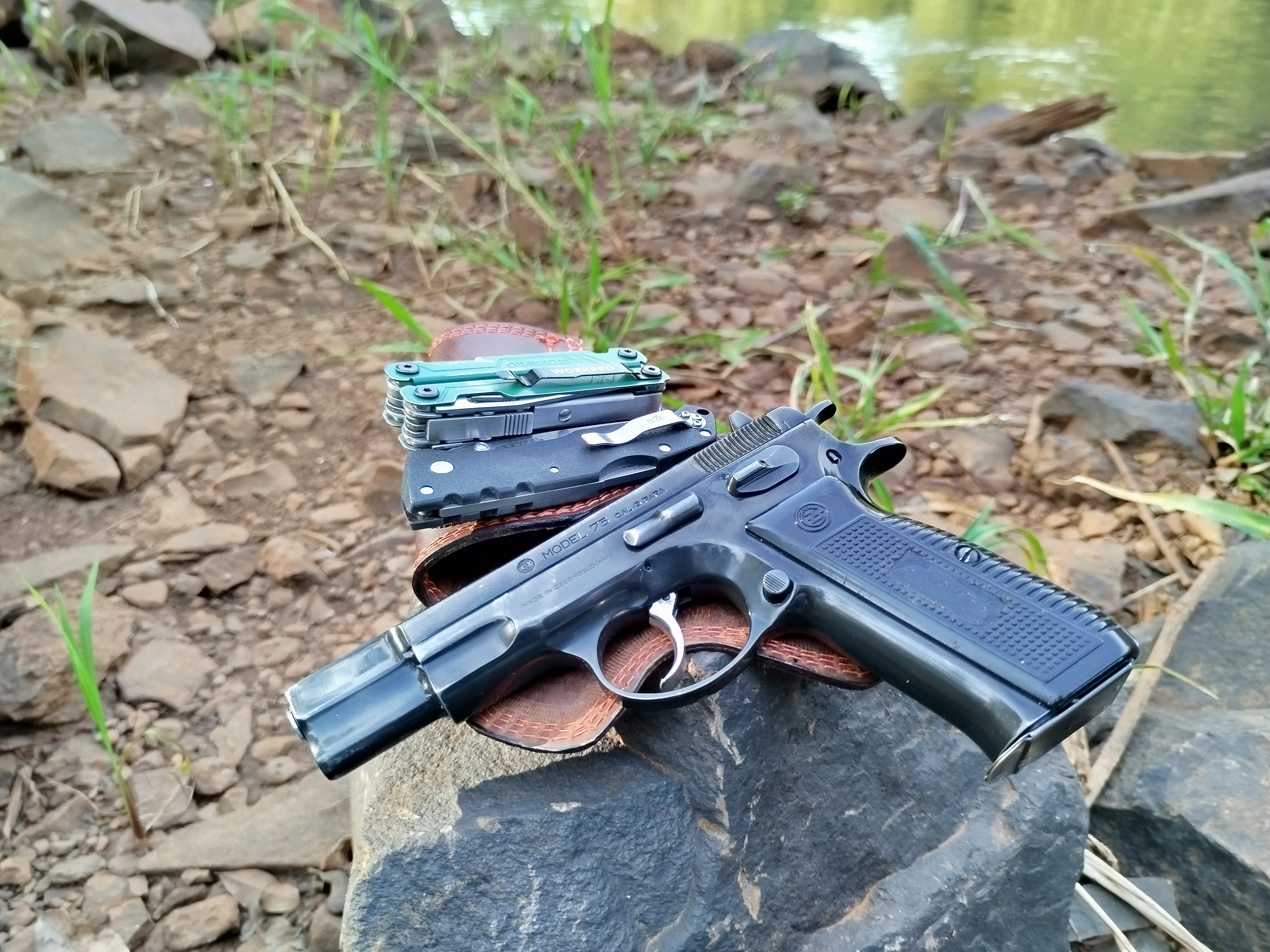
Here is my EDC setup during a short walk in the woods, following a great asado on a portable grill.
Pros
- Excellent ergonomics: Offers superb comfort and natural pointability.
- Superb trigger: Delivers a very smooth pull, even in double-action.
- Proven track record: Quite literally the most copied handgun design in the world.
- Impressive accuracy: For my first shots, I targeted a 500ml soda jug at around 17 metres. The rounds hit a bit low at first, but I was right on target by the third shot using CCI Blazer 115gr.
- Low-profile slide: The smaller slide surface area can be a bit tricky to grip firmly.
- No decocker: These older models lack a decocking lever, meaning you must manually lower the hammer by holding it while pulling the trigger.